Explore tailored services designed to solve business challenges and support growth
Discover industry-focused expertise built to meet unique business needs
Meet our service partners who strengthen delivery and support client success
Meet our service partners who enhance our capabilities, strengthen service delivery, and help drive successful outcomes for our clients.
Learn how to modernize data foundations to enable trusted, scalable AI.
See how a unified data strategy built faster insights and scaled analytics.
Explore our digital products built to streamline work and drive growth every day
Meet our product partners who enhance our solutions and expand client value
Explore a better way to speed up testing and improve release quality.
Access blogs, case studies, events, and insights that support smarter decisions.
We believe in creating a global workplace where everyone can grow. This is amplified by our teams, who say the best thing about Fortude is our culture, one that is brought to life by a diverse team that spans across continents.
Learn who we are, what we do, and the values that drive our growth
Stay updated with Fortude news, events, stories, and company highlights.
Get in touch with our team to ask questions or start a conversation
Your nearest office- Sri Lanka
Fortude (Pvt) Ltd
146 Kynsey Road, Colombo 7, Sri Lanka
Email – talk-to-us@fortude.co
Phone – +94 11 453 1531
Every day, we bring together diverse perspectives, strong leadership and responsible thinking to build a business that creates lasting value for our clients, people and communities.
Your nearest office- Sri Lanka
Fortude (Pvt) Ltd
146 Kynsey Road, Colombo 7, Sri Lanka
Email – talk-to-us@fortude.co
Phone – +94 11 453 1531
For organizations planning to move to Microsoft Azure, the goal is not simply to move workloads. It is to confirm whether the business is prepared to run, govern, secure, and optimize cloud services with confidence.
Cloud adoption is accelerating. Gartner reports worldwide sovereign cloud infrastructure as a service (IaaS) spending to rise to a total $80 billion in 2026, a 35.6% increase from 2025, with hybrid cloud adoption expected across most organizations through 2027. Yet many cloud programs still struggle because readiness is treated as a technical task rather than an enterprise decision.
Microsoft stresses that the Cloud Adoption Framework goes beyond technical readiness. It requires a cloud adoption plan aligned to business goals. To help organizations with this, the blog will discuss the key areas of a cloud readiness checklist and the importance of conducting a cloud migration assessment before moving to Microsoft Azure.
A cloud readiness checklist is a set of actions and considerations an organization needs to address before adopting, migrating to, or modernizing in the cloud. It helps enterprises assess whether their strategy, workloads, people, governance, security, and cost model are ready for cloud adoption.
It helps leaders answer practical questions:
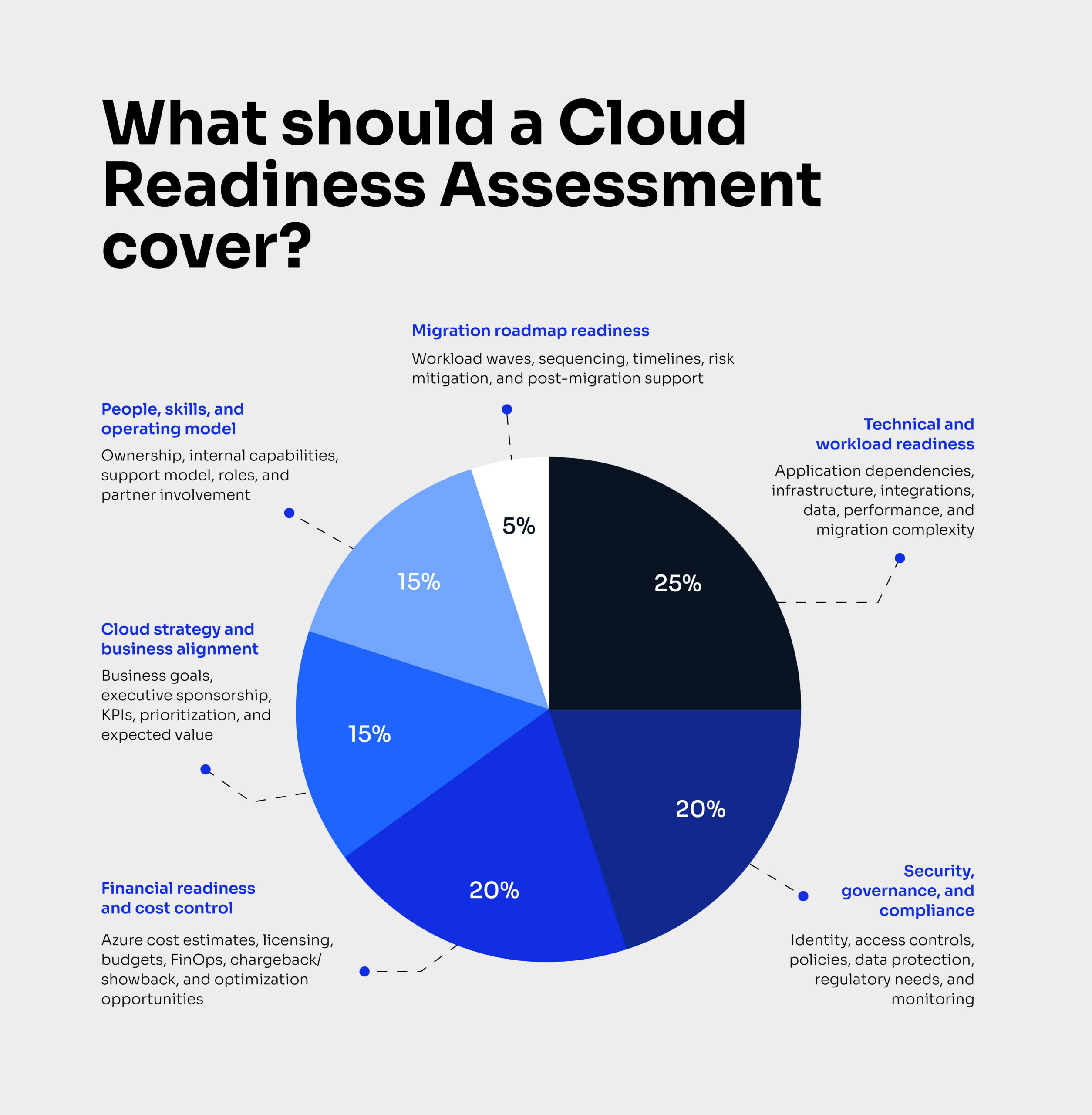
A strong cloud readiness checklist should cover technology, business alignment, operating model, skills, financial posture, and risks.
Readiness matters because Azure success depends on more than infrastructure deployment. Enterprises need the right landing zone, operating model, governance policies, identity controls, workload priorities, and cost discipline before scaling.
The Cloud Adoption Framework organizes adoption into stages including: Strategy, Plan, Ready, Migrate, Modernize, Govern, Secure, and Manage. A practical cloud readiness checklist should reflect the same logic and so does Fortude’s Azure CAF Accelerated Review, which applies this framework as a structured assessment to identify where an organization stands and what needs to happen before migration begins.
Without this foundation, cloud migration can create new problems:
For Microsoft cloud readiness, the key question is not “Can this workload move to Azure?” It is “Can this workload deliver measurable value once it is running in Azure?”
A cloud readiness checklist is broader than a migration assessment.
Area
Cloud readiness checklist
Cloud migration assessment
Focus
Business, technology, security, cost, people
Workload movement
Timing
Before or during cloud planning
Before migration execution
Output
Readiness gaps and roadmap
Migration plan
Scope
Enterprise-wide
Application or infrastructure-specific
Best for
Microsoft cloud readiness and adoption planning
Migration wave execution
Enterprises usually need both. The cloud readiness checklist confirms whether the organization is prepared. The migration assessment confirms how specific workloads should move.
* The percentages shown represent indicative priority areas only. They may vary based on your business requirements and should not be considered benchmark figures.
1. Is your cloud strategy linked to business outcomes?
Your cloud strategy should define why the organization is moving to the cloud and what outcomes matter.
Your checklist should confirm:
This is where many cloud programs drift. The migration team may focus on servers and applications, while business stakeholders expect agility, faster reporting, or better customer experience.
2. Are your workloads technically ready for Microsoft Azure?
Technical readiness determines whether applications, integrations, data, and infrastructure can move to Azure without unnecessary disruption.
Your cloud readiness checklist should review:
Readiness should also include Azure landing zone readiness, identity design, networking, monitoring, and workload architecture.
Not every workload should move in the same way. Some can be rehosted. Others should be replatformed, refactored, retired, or replaced with SaaS. The checklist should help make those decisions before migration begins.
3. Are governance, security, and compliance built in early?
Security should not be added after migration. It should be designed into the cloud operating model from the start.
A cloud readiness checklist should validate:
CAF includes dedicated guidance for governance, security, and managing cloud environments. For enterprises, this is especially important when multiple teams, regions, applications, and vendors share the same cloud estate.
4. Do your teams have clear ownership and skills?
Azure readiness is also an organizational issue. Teams need to know who owns architecture, security, operations, cost, application support, and vendor coordination.
Your checklist should ask:
Microsoft notes that a cloud operating model defines how an organization manages cloud resources, team responsibilities, and collaboration.
5. Is your financial posture ready for cloud consumption?
Financial readiness determines whether cloud spend can be forecasted, governed, and optimized.
This is no longer optional. Flexera’s 2026 State of the Cloud Report found that wasted IaaS and PaaS cloud spending reached an estimated 29%, reflecting the growing cost complexity associated with AI and new cloud services.
A cloud readiness checklist should include:
6. Do you have a practical migration roadmap?
A migration roadmap turns assessment findings into sequenced action.
Your roadmap should define:
These risks are worth naming directly, because they are the gaps that a structured readiness process whether a self-assessed checklist or a formal CAF assessment is designed to prevent:
Addressing these before migration is precisely what both the checklist and the CAF assessment are designed to do. Cloud can improve agility, but only when the operating model is ready.
Start by aligning business and IT leaders around one practical question: “What must be true for our cloud adoption to succeed?”
Then work through the checklist in this order:
Fortude helps enterprises assess Microsoft cloud readiness through a structured Azure CAF Accelerated Review. It is best suited for organizations with an unclear cloud strategy, growing Azure environments, limited cost visibility, or skills and ownership gaps.
Fortude can also support the next stages of execution, including Azure governance, security hardening, cloud migration, Microsoft licensing optimization, managed services, and ongoing cost optimization.
Ready to understand where you stand on your Azure journey? Explore Fortude’s Azure CAF Accelerated Review or speak to our cloud experts now.